
UnPHILtered (Part 1)
A retrospective on the first 20 years of my writing life.

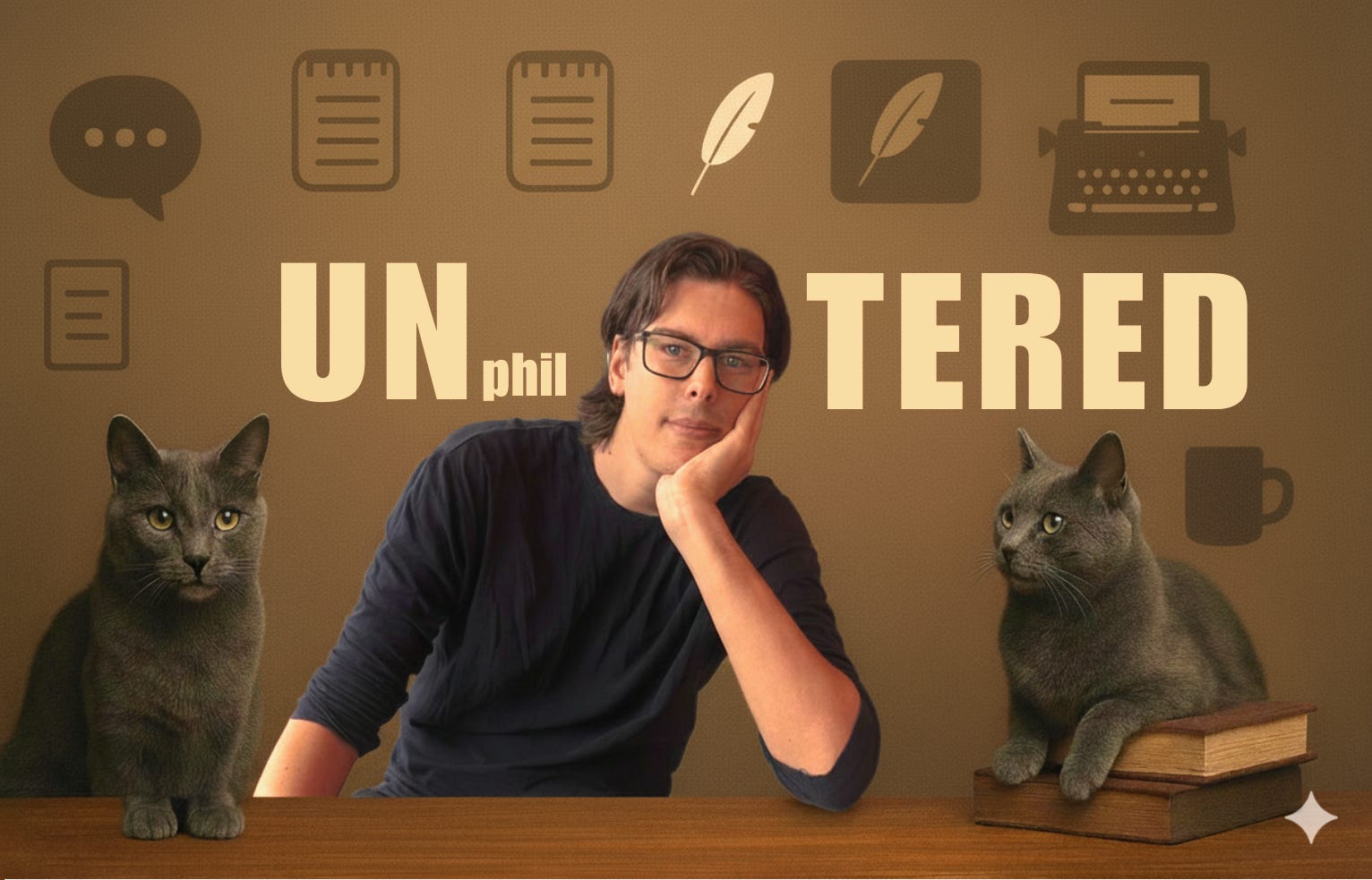
* This article covers chapters 1-4 of UnPhiltered from 2008-2015. Chapters are published weekly as notes on Substack and other socials.
Chapter 1 - Executive Summary
What I’m about to say is a lie.
Ready?
I’ve always been a writer. Ever since I was a kid, I’ve been churning out effortless stories and witty takes.
Now for the truth...
“I’ve always written” is a tired trope, and it ignores the work writers do to improve. Reading helps. Good teachers help. But we all start from zero.
For example, the first story I wrote (aged 6) was about the 1960s singer, Sir Cliff Richard, blowing up a fish and chip shop. I believe it ended with an innocent diner enquiring, ‘Why is there a grenade in my fish and chips?’
Talent is nonsense, and most young writers get stuck pumping out stuffy essays until they can graduate, get a job as a corporate drone, and start pumping out stuffy reports and insincere emails. Actually, the most creative aspect of my job in advertising was finding the right statistics to sell billboard space to other London-based media twonks.
It was at this job that I started writing an industry-insider blog about how much of a circlejerk advertising is. The blog was called ‘Executive Summary’, and it was absolutely terrible. (I still have access to it, but I don’t want you to see it.)
They say you have to write a million words of crap to learn your trade. Well, this blog was 100+ posts full of thinly veiled outrage, half-baked stories, and poorly drawn characters. I even used the company photocopier to scan in ‘bad’ classified ad examples I wanted to dissect.
There was an anonymous column in ‘Media Week’ at the time (2008-11). I dreamed of my secret blog getting picked up by The Evening Standard or the London Lite, so commuters could chuckle at the bile and wit in my columns. Three things stopped this from happening:
I didn’t know how to attract readers.
I didn’t know how to approach a publisher
The blog was terrible.
I assumed there would be thousands of ‘cubicle farm tales’ or ‘boardroom secrets’ blogs out there, but I struggled to find them. No writers’ community. No readers. So, even though I wrote an ‘anonymous’ column, I told everyone in the office about it (omitting the fact I wrote it on company time).
This actually got me into a bit of hot water, as the PR manager at the firm called a meeting with me and suggested I not rib the director’s mates so viciously.
“It’s a personal blog,” I said. “I don’t use real identities or company names.”
I went straight back to my desk to work on a new post.
Two lessons there:
Always stand up to censorship.
Framing words as fiction stops you getting censored.
Blogging in the 2000s was great. It truly was a little secret club of terrible writers who had figured out that they could publish, and no one could stop them.
I learned a bit about formatting, the web, and how difficult it is to get readers as an anonymous blogger.
My final post (April 2011) reads as follows.
“Hi all,
I have decided to move on from my position in advertising to bigger and better things. Essentially, I wanted to halt my progress towards becoming a fully blown media wanker.”
Then I logged off and went to live in Buenos Aires.
Chapter 2 — The Monday Night Club
“A university professor, a gay rights activist, a sewage farmer, a sailor, a pensioner, and a barmaid walk into a bar. This is not a joke.”
In Chapter 1, I told you about my brilliant Fish-and-Chip-shop story and my woeful office blog.
Before we get onto ‘the wandering years’ (including Argentina, Mexico, Asia, and Spain), I’ll shed light on the origins of my creative writing.
Back in 2010, I’d decided to leave my advertising job and had cooked up a scheme to teach English abroad. Argentina seemed like an exotic destination — far away enough that I couldn’t turn back, and close enough in terms of ‘European’ culture. I took Spanish classes at an adult-ed center called City Lit (I still remember reciting the Spanish alphabet to myself again and again on the cycle ride home).
Then, after I could recite my Spanish ABCs, I took a creative writing course. There was no real trigger for this, but it felt good to learn again, so I signed up for Monday night writing sessions. When you break the cycle of 9-5 exhaustion, Netflix, and hangovers, you realise you can learn anything, even on a Monday night.
In a way, I think the best motivation for taking a writing course is ‘just to see’. I had no goals of publishing anything. I’ve always collected creative outlets: music, poetry, comedy videos [file missing], and passive-aggressive blogs.
The quote at the beginning of this post relates to the City Lit writing course I took in 2010.
It was run by a very patient feminist writer called Zoe Fairbairns. Each week, we studied some examples of poetry, fiction, descriptions, and so on, before sharing our own writing with the class.
I began to read a greater variety of writing. Short stories weren’t pointlessly brief stories anymore — they became puzzles to unravel. We learned to read twice (once for enjoyment, and once to ask ‘how?’). After 2 or 3 weeks, I began to see that the real story was the twelve disparate characters who attended the course with me. Not one of them came from a boring 9-5 background. They all led weird and wonderful lifestyles, which resulted in us sharing stories over stale machine coffee at 9pm every Monday night. Outside, the grey London drizzle fell, and I dreamed of Buenos Aires.
The result? I didn’t keep in touch with anyone, and I didn’t even start writing fiction for another 5 years!
But the people on the course stayed with me to the extent that I immortalized them in fiction when I did start to craft stories. In 2019, my humorous take on the course, ‘The Monday Night Club’, was shortlisted for a comedy writing competition. You can read it here .
Oh, and I changed the nice course leader, Zoe, into a pompous prick called Marcus.
Chapter 3 — Good Airs
The quarter-life crisis arrives a few years into your career.
‘Is this it?’ You think.
‘I’m supposed to do this for the next 40-45 years? Maybe if I redouble my efforts, forgo avocado toast forever, and marry a countess, we might be able to afford a two-bedroom flat above a betting shop in a commuter town called something like Wallythorpe or Pynchbottom-on-Thames.’
I left for South America.
Travel makes you live in the moment. The only looking back you do is to organise your experiences into a coherent blog for your family and friends — you know, so they remember to be jealous.
My site was called Tall Travels.
I wrote weekly. Raw, sarcastic, and poorly edited posts.
I had all the tools I needed to create something great — a sharp observer’s eye, creativity, unlimited time and energy, inspiring people, and formative experiences.
I particularly fell in love with Argentine culture in Buenos Aires — midnight dinners, literary discussions, film festivals, rock music, street art — I drank it all in… especially ‘yerba mate’, which I drank before the Hollywood celebrities. I learned Spanish, played 5-a-side football with locals, and wrote songs on a faulty steel-stringed guitar.
Tall Travels was self-expression. I still believe that your primary audience should be yourself. However, that does confuse potential readers of your travel blog. They expect ‘10 Cozy Cafes in Buenos Aires’s Upmarket Palermo Neighborhood’, not ‘A Conversation Between Overweight Farmers on a 14-Hour Bus Journey’.
My travel blog never looked attractive. In fact, I’ve always been against taking pictures. It feels like an alternate version of reality, and pressing your face to an SLR eyepiece and clicking the shutter means you are not really looking at life. You’re not really experiencing your trip. I took a few shots on a clunky digital camera — Machu Picchu, the expansive Bolivian Salt Flats, the grassy Pampas of the Andean foothills — but they never felt like mine. One time, I watched hundreds of tourists scramble to take the same photo at Iguazu Falls, then I wrote about it in the hostel.
The posts were rants. I needed to process why everyone seemed to act so differently. This formed part of my ‘write a million words of garbage’ training.
Writing comes easy when you are feeding your soul with so many new experiences. When everything is the same, you have to trick yourself to draw the words out.
Like many forms of writing, travel blogs aren’t very honest. But, I captured the landscapes in the camera of my mind. The characters of Peru, Bolivia, Chile, Uruguay, Argentina told the kinds of stories I’d never heard before. I wrote those stories later, after I processed what they meant.
Mexico would be the next place to feed my writing journey. And luckily, I like spicy food.
Read my story about two very different ladies in La Recoleta Cemetery. It’s available for free in the preview of my first book, Foreign Voices.
Chapter 4 — Cinematic Moments
It’s Autumn 2015, and I’m watching my buddy’s horse in an unsanctioned winner-takes-all race on a farm outside Oaxaca City.
The horses thunder down the quarter mile of red dirt track towards the finish line. A few dozen spectators watch from their pickup trucks, beers in hand. The sun bakes down.
This is like a movie, I think. I’m not sure who the main character is, or what happens at the end, but it’s a moment.
I had many such moments in Mexico. Witnessing a shooting in a bar, haggling with vendors at the weekly market that brought half the state to my little backwater town, riding through the mangroves, past a crocodile farm to an isolated surf beach.
Drugs. Dances. Day of the Dead. Every day something wild. Almost every experience in my three years living in Oaxaca was worthy of writing about.
Writers must fill their tank with inspiration (as well as tequila). It’s a feeling - that kernel of an idea stored in the vault of your mind. I collected years worth of material from my travels through Latin America.
In Oaxaca, I had the best job of my life. I was teaching English to university students.
While I wasn’t very successful in getting them to say much other than ‘teeeeaaacher’ and ‘may I go bathroom?’, there were many advantages to the job:
Creative freedom in lesson planning.
Several free hours a day to write my blog.
Copious amounts of tacos.
The university staff comprised a host of pompous Mexican professors teaching nutrition, nursing, and municipal planning; the students were sweet yet naive rural kids who were more likely to have studied Pokemon than Potemkin. Still, lessons were fun, and I tried not to be pretentious, even insisting the class called me Phil instead of ‘teeeaaacherrrr’ (which took away 50% of their vocabulary).
Some of my teaching colleagues were authors and bloggers too. We had A LOT of free time.
We jotted down many observations about life in the town, our travels, and our work. My blog, Tall Travels, softened a little. It became a site for cultural commentary as well as travel stories. I was processing life, crunching the data, and refining the output.
And later, the seeds of those cinematic moments grew into the stories of my first book.
The next year, I moved to Spain and called myself a writer for the first time. That was when the real work started
Two examples of stories from Mexico.
The Feature Race - a fictionalized version of the race I attended in Oaxaca.
Market Day - a poem about the weekly market in Miahuatlán
In the next chapters, I become a published writer and author.
Great to hear some of your back story, Phillip. I can relate to being in the spell of corporate London yet dreaming of adventures far away. A sketching course in a church at the end of Waterloo bridge provided a creative boost for me just before I left for Cambodia.